Free Information
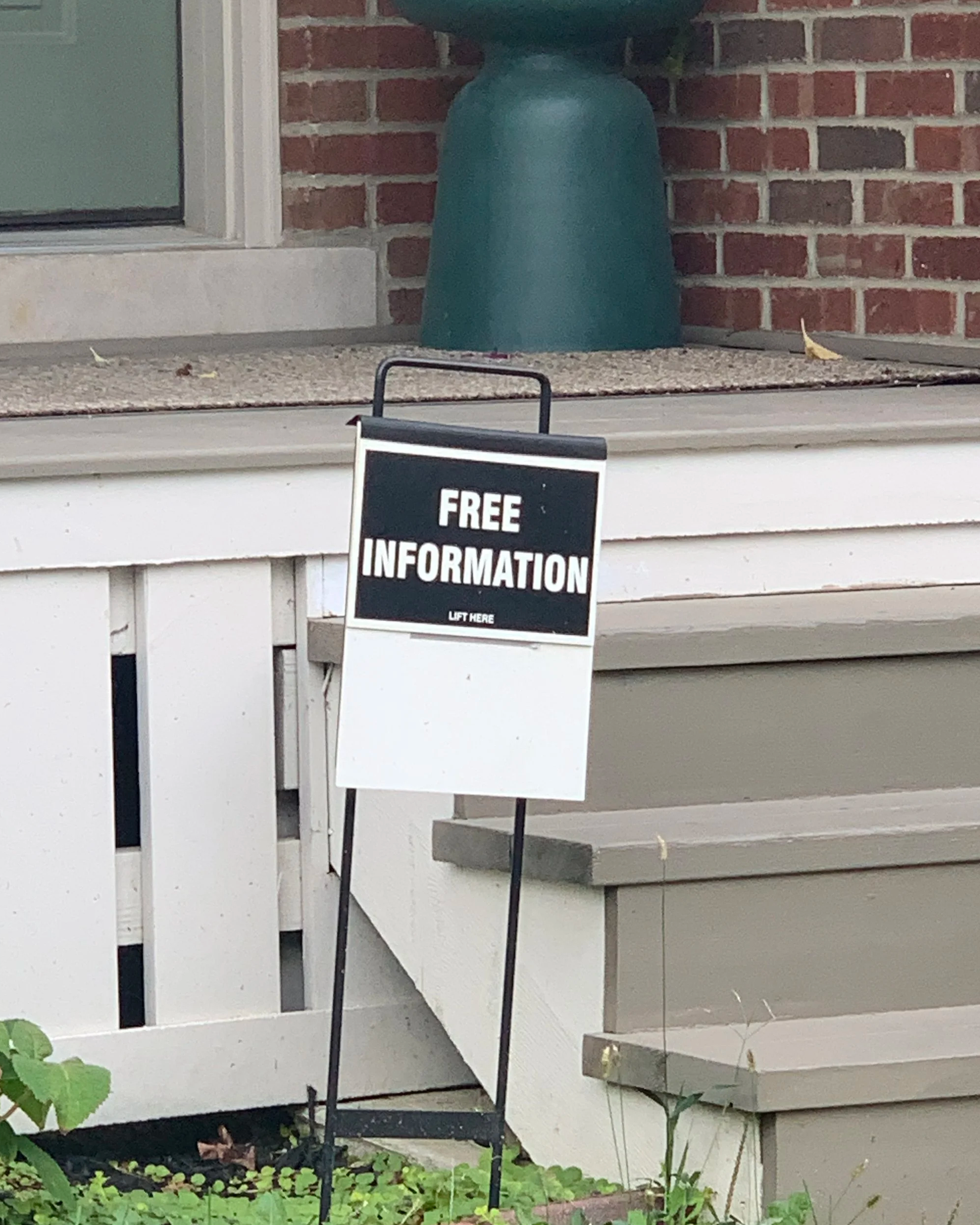
A sign in front of a home that says “Free Information” in white text against a black background
Design in the World is a series of interesting moments and reflections on how design has an impact on making the world easier or harder to navigate.
Free Information
Often in design (and I’m sure many other professions) we go through the exercise of translating unstructured data into structured data which in turn becomes information for someone to (hopefully) understand to build knowledge. This is a theme in the book “Figure it Out: From Information to Understanding” from Karl Fast. In this day and age of LLM and Gen AI however, the question is less about “how might we get the information that we need?”, and is rather “how might we source quality information about what we need?”. For many professionals, their day-to-day knowledge work can be summarized with (as a client pointed out)- “You’re doing what you can with the information that’s available to you, but that information is evolving.” Times are moving fast, and it feels like today there is an abundance of information out there given away practically for free- and the quality filter has seemingly slipped down the drain. Where misinformation, disinformation, and malinformation, especially on social media, was a big issue 10-15 years ago at the height of Web 2.0, the landscape for sourcing quality unmuddied, unbiased, information is harder than ever before. It’s becoming rare, valuable. Where businesses in the past were making bets on assumptions with gaps in knowledge, they are now being led down promising paths that look increasingly more convincing due to beautiful looking vibe coded interfaces and dummy data. To demonstrate this point…
A few years ago we were shopping out houses while at the same time I was working on a travel-related project. We had been scouring doing secondary research to understand more about the traveling habits of people in New York. One big question that we wanted to learn more about was how long the average train traveler in NYC spent inside of train stations before boarding their ride. We didn’t have access to New York at the time, but there was this software called Chat GPT that was apparantly really good at answering questions like this. In a naive motion, I asked the machine the question and it returned back something to the tune of “15 minutes”, I asked for sources and it spat back a few fake links. I presented this finding to my client, and as I opened the source links, the browser directed to a 404- File Not Found. The sources and the information were both not real. Embarassed, I went for a walk outside- and noticed a sign out in front of a house… “Free Information”, I chuckled to myself.
As designers our responsibility to ensure that quality, meaningful, information reaches the end user could never be so important. Our ability to say “I don’t know, let me do some research” is what separates us from the LLM. I acknowledge that as humans we are prone to error as well, saying “I don’t know” can be hard for us as well in the face of knowledge-hungry partners, constraints, or a simple bias to try and fill in the gaps and move on. In this day and age access to information is not hard. We can get an answer from an LLM that has trouble saying “I don’t know” in less than a minute to any inquiry. A lot has happened over the past few years with LLM, but the risk of hallucinated information hasn’t gone anywhere. As designers our role is to translate data into information, and to demonstrate it in a way that builds customer knowledge and understanding. That much hasn’t changed. We can use AI to synthesize data into meaningful insights, but only if the data fueling that information is good. Otherwise, we just end up with free information.
#CertifiedOrganic